
Click here for my blogThoughts and ideas about capoeira
Mestre Fantasma
I became interested in capoeira the first time I saw it. It was as if one great long search had come to an end and another was about to start. I had become interested in fighting arts when I was 19 when living alone in Newcastle-upon-Tyne it became more important to stand up for myself. I was a weak, skinny individual that lacked confidence, stuttered and had eczema. Within two weeks of training with a Karate master, I stopped stuttering, lost the eczema, and felt I had found something that could help me turn my life around. The training was hard and I soon learnt how to fight. I won a few competitions and became interested in all traditional fighting arts. I saved money to go to Asia but then saw capoeira…
Although I was unqualified it didn’t take long before my passion had inspired a gang of new and old friends to start training in a multistory car park four times a week in southend-on-sea! We all became enthusiasts and as a group we attended workshops and classes of visiting mestres throughout the 90’s and even hosted a few classes in the car park. We all loved what we were doing and capoeira became a big part of our lives; I became the leader by accident – and we all changed.
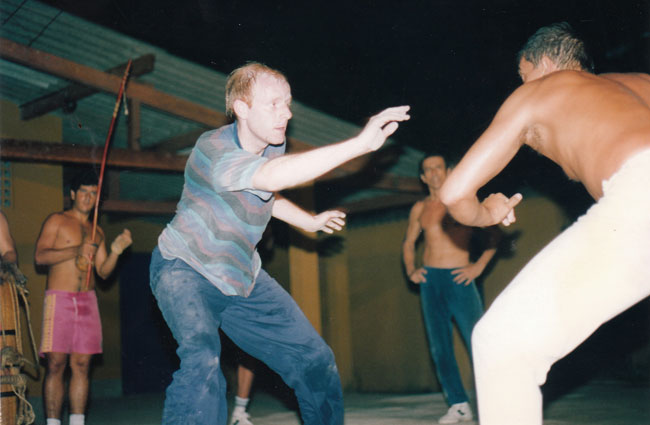
In 1993, I visited Brazil with Senzala’s mestre Gato who introduced me to mestre Marrom’s group in Rio-de-Janeiro and it was his training methods that I started to adopt when I was back in UK. Throughout the 90’s I visited Brazil in the quest to learn Portuguese and develop my own vision of capoeira. I’ve always been happy with teaching capoeira because I see how a few individuals follow my idea’s and improve their quality of life just as I had.
Recently I graduated from the School for Social Entrepreneurs (SSE) with the ambition of using Brazilian capoeira to positively impact on local communities in the UK and this is now happening. Being a ‘master’ or running a capoeira group isn’t all play; it is a serious position although the important things are simple like turning up on time, being honest, humble, keeping your instruments in good order, and having a vision that is yours and not someone else’s.
I don’t know where I’d be if I didn’t do capoeira. I get great reward from seeing people grow, change and develop their life. I have been lucky – I found something that allows me to show my passion, and my contribution back is guiding those that become passionate about the same thing.”

